FLSA Time Tracking Requirements: What Records You Must Keep
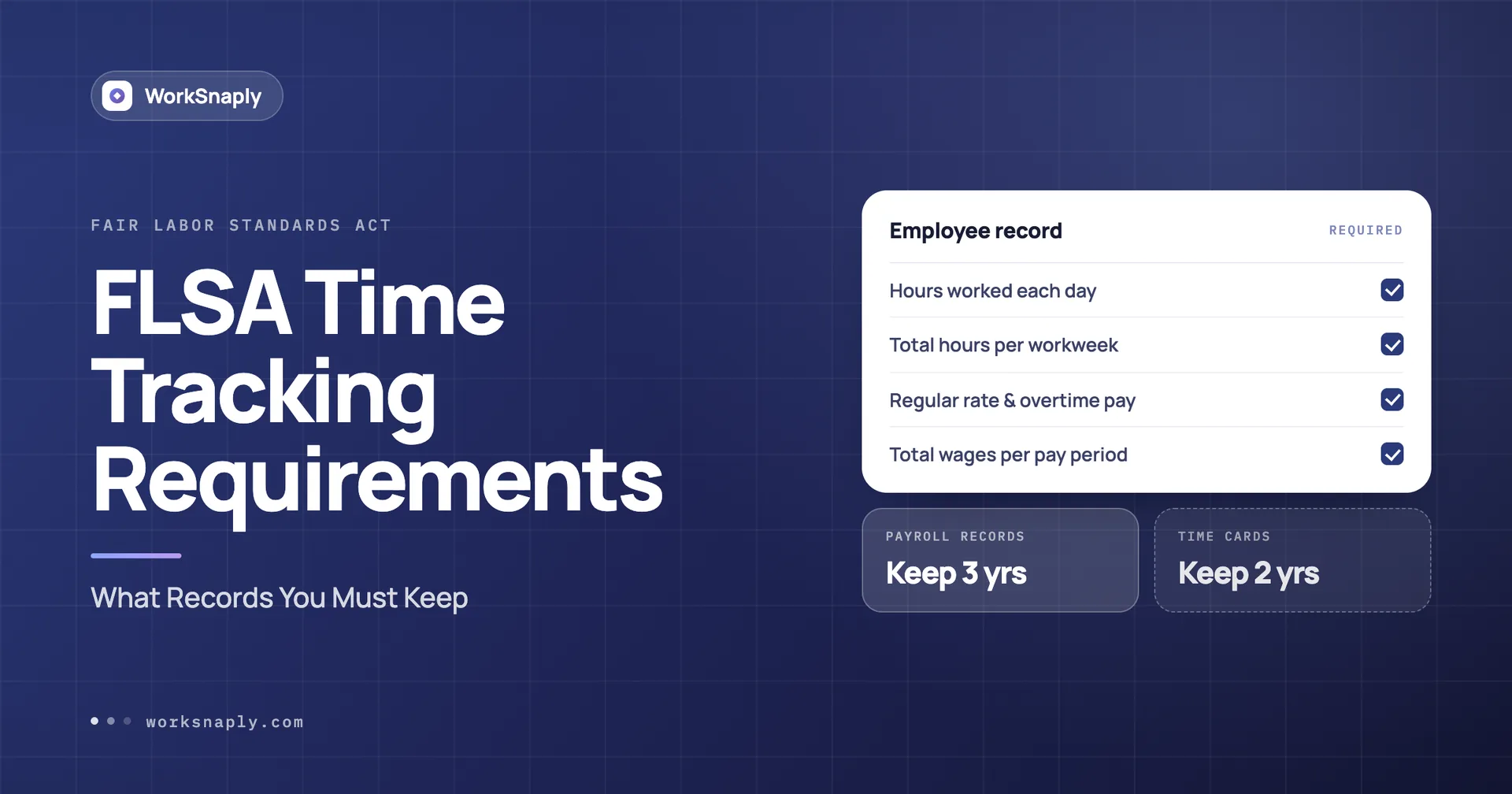
FLSA time tracking rules in plain words: which hours records to keep, for how long, whether rounding is legal and how the workweek affects overtime.
Last updated: November 13, 2026. Sources checked November 2026.
The Fair Labor Standards Act requires US employers to keep accurate records of hours worked each day and each workweek for every nonexempt employee. It does not require a time clock or any set form. You keep payroll records for at least three years and time cards for two. State laws can add more.
Key takeaways
The Department of Labor says every covered employer must keep certain records for each nonexempt worker, including hours worked each day and total hours each workweek.
No particular form is required. A time clock, a timekeeper, workers writing their own times or software all work if the record is complete and accurate.
Payroll records must be kept at least three years. Time cards and other wage computation records should be kept two years.
Rounding to the nearest 5 minutes, tenth of an hour or quarter hour is accepted only if it does not shortchange employees over time.
This post covers federal law in the United States. Your state may require more, so check your state labor department.
What records does the FLSA require employers to keep?
The FLSA requires every covered employer to keep identifying, hours and pay records for each nonexempt worker, and the hours records are the ones time tracking has to support.
The Department of Labor lists the information in its Fact Sheet 21. Here is the part that matters most for timekeeping, with the wage items grouped at the end.
| Record | What it covers |
|---|---|
| Employee identity | Full name, social security number, address, birth date if younger than 19, sex and occupation |
| Workweek start | Time and day of week when the employee workweek begins |
| Daily hours | Hours worked each day |
| Weekly hours | Total hours worked each workweek |
| Pay details | Basis of pay, regular hourly rate, straight time and overtime earnings, deductions, total wages and payment date |
Notice what is on the list. The law asks for hours per day and hours per week, not just a weekly total. A single number at the end of the week does not meet the daily line. Who is covered also matters, because these rules apply to each nonexempt worker. Exempt status is a separate question that this post does not decide for you.
Do you have those two hours lines for every nonexempt person today, in one place you could hand over on request?
If you need a starting point for the layout, see our guide on what a timesheet is and our free timesheet template.
Does the FLSA require a time clock or special software?
No. The Department of Labor says the Act requires no particular form for the records, and any timekeeping plan is acceptable as long as it is complete and accurate.
The fact sheet names three ways to collect hours. Employers may use a time clock, have a timekeeper track the hours, or tell workers to write their own times on the records. The federal regulation on time clocks says it plainly: time clocks are not required.
The fact sheet also allows a shortcut for fixed schedules. An employer may keep a record showing the exact schedule of daily and weekly hours and note that the worker followed it. If the worker did not, the employer must record the hours actually worked, on an exception basis.
One limit to keep in mind. The fact sheet states that the law requires this information to be accurate. A schedule on the wall is not a record of what happened on a Tuesday when someone stayed two hours late.
The fact sheet was last revised in July 2008, and it does not mention software or electronic records. That means it neither requires nor rules out a digital tracker. It only asks that the record be complete and accurate. Our guide to how to track time at work compares the common methods.
How long must employers keep time records?
Payroll records must be kept for at least three years, and records used to compute wages, such as time cards, should be kept for two years.
| Record type | Minimum period |
|---|---|
| Payroll records, collective bargaining agreements, sales and purchase records | 3 years |
| Time cards, wage rate tables, work schedules and wage additions or deductions | 2 years |
Records may be kept at the place of employment or in a central records office. Retention is the easy part to get wrong, because time data often lives in a tool the company later stops paying for. Where will your 2026 hours records sit in 2029?
The actual retention rule sits in the federal regulations, 29 CFR Part 516. Section 516.5 covers the three year group. State laws sometimes require longer periods, so treat these numbers as the federal minimum.
Is rounding time legal under the FLSA?
Yes, but only when it does not fail to pay employees for all the time they actually worked, measured over a period of time.
The regulation, 29 CFR 785.48, notes that employers have long recorded start and stop times to the nearest 5 minutes, one tenth of an hour or quarter hour. It says that presumably this arrangement averages out so that the employees are fully compensated. For enforcement purposes the practice will be accepted, provided it is used in a way that does not result, over a period of time, in failure to compensate employees properly for all the time they have actually worked.
Illustrative example: a worker punches in at 8:57 and out at 5:04 and the employer rounds to the nearest quarter hour. The punch in becomes 9:00, which cuts 3 minutes, and the punch out becomes 5:00, which cuts 4 minutes, so the worker loses 7 minutes that day. Over 250 working days that is 7 x 250 = 1,750 minutes, or 29.17 hours. At $20.00 an hour that is $583.33 unpaid. A policy that only ever rounds down does not average out.
The same section adds that major discrepancies between clock records and actual hours should be discouraged, since they raise a doubt as to the accuracy of the records. If you use rounding, review it regularly against the raw punches. Our hours calculator for decimal hours shows how minutes convert to decimals.
How do the workweek and overtime affect your records?
Overtime is counted per workweek, so your records must show hours by workweek, and the Department of Labor says averaging hours over two or more weeks is not permitted.
Fact Sheet 23 says nonexempt employees must receive overtime pay for hours worked over 40 in a workweek at a rate not less than time and one half their regular rates of pay. It defines the workweek as a fixed and regularly recurring period of 168 hours, seven consecutive 24 hour periods.
Illustrative example: an employee earns $20.00 an hour and works 44 hours in one workweek. Formula: 40 x $20.00 + (44 minus 40) x $20.00 x 1.5 = $800.00 + $120.00 = $920.00. This is why the workweek start day on your record matters. Shift the workweek start and the same hours may land in different weeks.
You can test your own numbers with our overtime calculator, and if you pay on a biweekly schedule, read what biweekly pay means for how pay periods relate to workweeks.
How should remote and hybrid teams record hours?
The same way as an office team, with a record of daily and weekly hours for each nonexempt employee that is complete and accurate, wherever the work happens.
The fact sheet does not carve out remote work, so the rule does not change when the desk moves home. What changes is how you collect the data. With nobody at a time clock, many employers rely on self reported timesheets or a tracker. Self reporting is allowed, since workers may write their own times, but it still has to be accurate.
A short checklist helps teams of any size.
Pick one workweek start day and time and write it down
Record start and end times each day, not only the weekly total
Capture unpaid break time the same way every day
Review rounding rules against raw punches each quarter
Store records where you can produce them for three years
Our guide to time tracking practices for remote teams adds team habits that keep records honest.
Where does a time tracker like WorkSnaply fit?
Disclosure: We build WorkSnaply, so judge this section with that in mind. A tracker helps you collect the hours, but it does not make you compliant on its own.
WorkSnaply is built for office, hybrid and remote teams, with time tracking, attendance, team reports and activity, a task planner, website and app activity tracking, invoicing and payroll. Starter at $3.19 per user per month on annual billing covers time tracking, basic reports and a task planner. Professional at $6.39 adds screenshots and activity monitoring, and Enterprise at $15.19 adds payroll. Every plan has a 14 day free trial with no credit card. Compare any report you pull against the list in the first section before you rely on it.
One caution on any software. Legal compliance depends on your facts, your state and your classification of workers. This post is general information, not legal advice, so ask an employment lawyer or your state labor department about your case.
Related reading
Try tracking hours the simple way
WorkSnaply covers time tracking, attendance and team reports for office, hybrid and remote teams, and every plan has a 14 day free trial with no credit card.
Start free trialFrequently Asked Questions
Does the FLSA require employers to track employee hours?
Yes for nonexempt workers. The Department of Labor says every covered employer must keep certain records for each nonexempt worker, including hours worked each day and total hours worked each workweek.
Do employers have to use a time clock?
No. Fact Sheet 21 says the Act requires no particular form, and employers may use a time clock, a timekeeper or workers writing their own times, as long as the plan is complete and accurate.
How long do employers have to keep time records?
Payroll records must be kept at least three years. Records used to compute wages, such as time cards, should be kept two years. These are federal minimums, and your state may require longer.
Can employers round employee time?
Yes under the federal regulation, to the nearest 5 minutes, tenth of an hour or quarter hour, as long as it does not result over time in failure to pay employees for all the time they actually worked.
Can employees record their own time?
Yes. The fact sheet says employers may tell workers to write their own times on the records. The law still requires the information to be accurate.
Does this apply to remote workers?
The fact sheet makes no exception for remote work, so a nonexempt remote employee needs the same daily and weekly hours records as an office employee.
Fact Check
| Claim | Source | Exact text from source |
|---|---|---|
| Employer must keep records for each nonexempt worker | DOL Fact Sheet 21, revised July 2008 | Every covered employer must keep certain records for each non exempt worker. |
| Identity, workweek start and wage items | DOL Fact Sheet 21 | Employee's full name and social security number. Address, including zip code. Birth date, if younger than 19. Sex and occupation. Time and day of week when employee's workweek begins. Basis on which employee's wages are paid. Regular hourly pay rate. Total daily or weekly straight time earnings. Total overtime earnings for the workweek. All additions to or deductions from the employee's wages. Total wages paid each pay period. Date of payment and the pay period covered by the payment. |
| Daily and weekly hours are required | DOL Fact Sheet 21 | Hours worked each day. Total hours worked each workweek. |
| No particular form, timekeeping methods and accuracy | DOL Fact Sheet 21 | The Act requires no particular form for the records. They may use a time clock, have a timekeeper keep track of employee's work hours, and tell their workers to write their own times on the records. The law requires this information to be accurate. |
| Fixed schedule records | DOL Fact Sheet 21 | The employer may keep a record showing the exact schedule of daily and weekly hours. The employer must record the number of hours the worker actually worked, on an exception basis. |
| Retention periods and where records may be kept | DOL Fact Sheet 21 | Each employer shall preserve for at least three years payroll records, collective bargaining agreements. Records on which wage computations are based should be retained for two years. The records may be kept at the place of employment or in a central records office. |
| Three year retention in the regulation | 29 CFR 516.5 | Each employer shall preserve for at least 3 years. |
| Time clocks are not required and large discrepancies | 29 CFR 785.48(a) | Time clocks are not required. Major discrepancies should be discouraged since they raise a doubt as to the accuracy of the records. |
| Rounding rule | 29 CFR 785.48(b) | Presumably, this arrangement averages out so that the employees are fully compensated. For enforcement purposes this practice of computing working time will be accepted, provided that it is used in such a manner that it will not result, over a period of time, in failure to compensate the employees properly for all the time they have actually worked. |
| Overtime after 40 hours and no averaging | DOL Fact Sheet 23, revised October 2019 | Hours worked in excess of 40 in a workweek at a rate not less than time and one half their regular rates of pay. Averaging of hours over two or more weeks is not permitted. |
| Workweek definition | DOL Fact Sheet 23 | An employee's workweek is a fixed and regularly recurring period of 168 hours, seven consecutive 24 hour periods. |
| WorkSnaply prices, features and trial | WorkSnaply pricing page, screenshots taken October 2026 | Starter $3.99 per user/month monthly, $3.19 annual, 1 user minimum. Professional $7.99 monthly, $6.39 annual, No minimum, Screenshots & activity monitoring. Enterprise $18.99 monthly, $15.19 annual, No minimum, Payroll. All plans include a 14 day free trial with no credit card required. |
| Computed figures | Arithmetic only | Not a quote from a source. Overtime: 40 x $20.00 + 4 x $20.00 x 1.5. Rounding: 7 minutes x 250 days. Quotes above have hyphens removed from the original wording. |