What Is Biweekly Pay? Definition, Calculation & How It Works
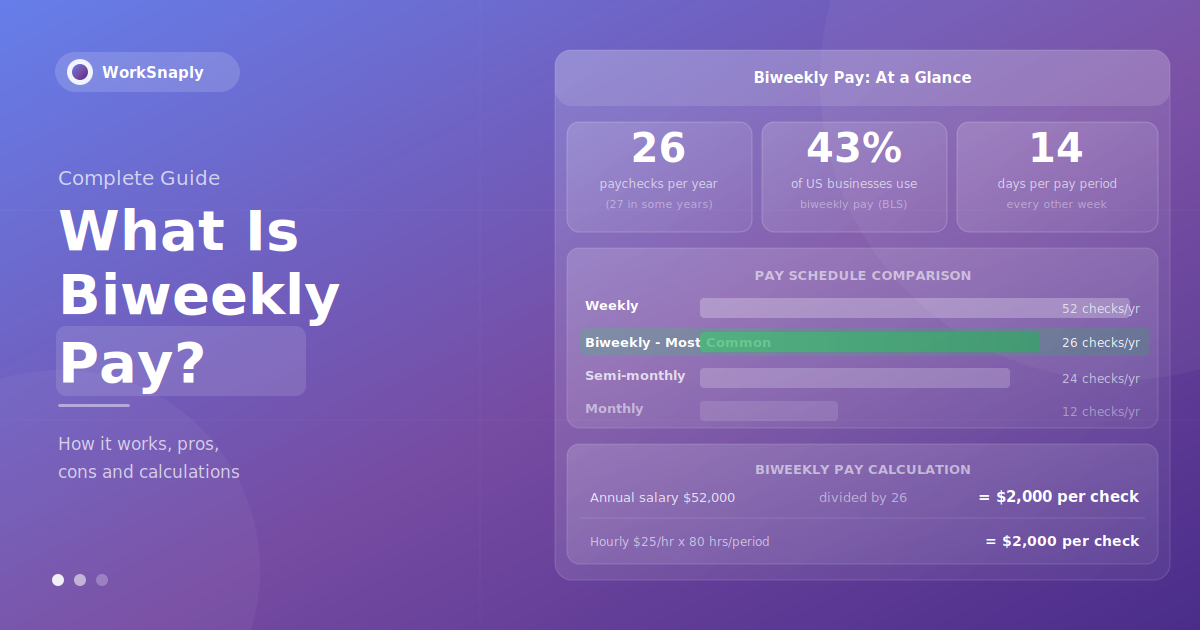
Biweekly pay means employees are paid every two weeks — once every 14 days — resulting in 26 paychecks per year.
Biweekly pay means employees are paid every two weeks — once every 14 days — resulting in 26 paychecks per year. It is the most common pay schedule in the United States, used by about 36.5% of private businesses (March 2013) according to the U.S. Bureau of Labor Statistics, and it applies to both hourly and salaried workers.
If you've ever wondered why some months have three paydays, or how your annual salary translates into each paycheck amount, this guide answers every question about biweekly pay — including how it works, how to calculate it, how it compares to other schedules, and what employers need to know about a special payroll quirk affecting 2026.
What Does Biweekly Pay Mean?
Biweekly pay refers to a payroll schedule where employees receive a paycheck every other week, consistently on the same day — most commonly Friday. Because a calendar year has 52 weeks, dividing by 2 gives you 26 pay periods annually.
Here's how a typical biweekly pay cycle works:
Each pay period covers exactly 14 days of work
The same weekday is always payday (e.g., every other Friday)
Most months contain two paydays
Two months each year will contain three paydays — often referred to as "extra paycheck months"
One common source of confusion: "biweekly" is not the same as "bimonthly" or "semi-monthly." These terms are often used interchangeably in everyday language, but they describe different payroll schedules with meaningfully different outcomes for employees and employers.
Biweekly vs. Semi-Monthly Pay: Key Differences
This is the most common source of confusion in payroll — and it matters more than it seems:
Feature | Biweekly | Semi-Monthly |
|---|---|---|
Pay frequency | Every 2 weeks (every 14 days) | Twice per month (e.g., 1st and 15th) |
Paychecks per year | 26 (sometimes 27) | 24 (always exactly) |
Pay day consistency | Always same weekday (e.g., Friday) | Same calendar date, varies by weekday |
Months with 3 paydays | Yes — 2 months per year | No — always exactly 2 per month |
Overtime calculation | Simpler — weeks align with pay periods | More complex — weeks can span 2 periods |
Most common in | Private sector, hourly workers | Professional and government sectors |
The practical impact: a salaried employee earning $60,000/year receives $2,307.69 per biweekly paycheck ($60,000 ÷ 26) but $2,500 per semi-monthly paycheck ($60,000 ÷ 24). The annual total is identical, but the per-period amount — and the months with extra paychecks — differ significantly.
All Four Pay Schedules Compared
Biweekly is the most common, but it's worth understanding how all four payroll frequencies compare:
Schedule | Pay periods/year | $52,000/yr paycheck | Best for | BLS usage |
|---|---|---|---|---|
Weekly | 52 | $1,000 | Hourly, construction, hospitality | 32.4% |
Biweekly ★ | 26 (or 27) | $2,000 | Most industries, mixed workforces | 36.5% |
Semi-monthly | 24 | $2,166.67 | Professional services, salaried staff | 19.8% |
Monthly | 12 | $4,333.33 | Some professional/government roles | 11.3% |
Source: U.S. Bureau of Labor Statistics, National Compensation Survey.
How to Calculate Biweekly Pay
For Salaried Employees
The formula is straightforward:
Biweekly pay = Annual salary ÷ 26
Examples:
$52,000/year ÷ 26 = $2,000 per paycheck
$75,000/year ÷ 26 = $2,884.62 per paycheck
$100,000/year ÷ 26 = $3,846.15 per paycheck
These are gross amounts — before taxes, benefits deductions, retirement contributions, and other withholdings. Your net take-home pay (what actually hits your bank account) will be lower.
For Hourly Employees
Hourly biweekly pay depends on hours worked in the 14-day period:
Biweekly pay = Hourly rate × Hours worked in pay period
Examples (standard 80 hours per two-week period):
$20/hour × 80 hours = $1,600 per paycheck
$25/hour × 80 hours = $2,000 per paycheck
$30/hour × 80 hours = $2,400 per paycheck
For hourly workers, overtime is calculated weekly under the Fair Labor Standards Act — any hours over 40 in a single workweek must be paid at 1.5× the regular rate. Because biweekly pay periods contain two complete workweeks, overtime calculations are cleaner than with semi-monthly pay periods, where a workweek can straddle two pay periods. Accurate time tracking is essential for hourly payroll — see our guide on what a timesheet is and how it works for the foundational context.

Understanding your biweekly paycheck amount starts with knowing how it's calculated. Photo: Unsplash
The Three-Paycheck Months Explained
One of the most popular features of biweekly pay — particularly for employees — is the two "bonus paycheck" months that occur each year. Here's why they happen:
A year has 52 weeks. If you're paid every other week, you receive 26 paychecks. But 26 pay periods × 2 weeks = 52 weeks, which covers exactly 364 days. A calendar year has 365 days (or 366 in a leap year). That one extra day means the math never divides perfectly into 12 equal months.
The result: while most months contain exactly two biweekly paydays, two months each year will contain three. Which months depends on when your biweekly cycle starts:
If your first 2026 payday is January 2, the three-paycheck months are January and July
If your first 2026 payday is January 9, the three-paycheck months are May and October
Many financial advisors recommend using three-paycheck months intentionally: applying the extra paycheck to debt paydown, emergency fund contributions, or savings goals — since your regular budget is already designed around two paychecks per month.
2026 Special Alert: The 27th Pay Period
For many employers paying on a biweekly schedule, 2026 brings a rare payroll event: a 27th pay period. This happens approximately every 11 to 12 years due to calendar math — 26 biweekly pay cycles cover only 364 days, and the accumulated one-day annual gap eventually reaches 14 days, creating an extra pay period.
For employers whose first 2026 biweekly payday falls on January 2, the 26th pay period ends December 18. The final payday would fall December 31 — creating a 27th payroll cycle in the calendar year.
The impact on salaried employees: If an employer calculated biweekly salary by dividing annual pay by 26 and doesn't adjust for 27 periods, a $52,000/year employee would receive $54,000 in 2026 — $2,000 more than their contracted salary. Employers that don't plan for this may find their 2026 payroll budget approximately 4% over plan.
How employers typically handle it:
Divide by 27: Recalculate biweekly salaries using 27 instead of 26 as the divisor. A $52,000 employee would receive approximately $1,925.93 per period instead of $2,000. The annual total stays at $52,000, but each check is slightly smaller.
Pay as usual: Keep the regular biweekly amount unchanged, accepting the additional payroll cost. Simpler to administer but increases labor costs for the year.
Employers handling the 27th period through salary recalculation are legally required to notify employees before implementing the change — state law varies, but one full pay period's advance notice is generally the minimum. Timing the adjustment to coincide with an annual salary increase minimizes the morale impact.
Advantages of Biweekly Pay
For Employees
Predictable paydays: Always the same weekday, making budgeting and bill scheduling straightforward
More frequent than monthly: Two weeks is a shorter gap between paychecks than monthly pay, reducing financial stress
Three-paycheck months: Two months per year with an extra paycheck, useful for savings or debt payoff
Overtime is clear: Each pay period contains two complete workweeks, making overtime calculations transparent
Widely understood: As the most common schedule, biweekly pay aligns with how most financial tools, budgeting apps, and employer systems are designed
For Employers
Simpler overtime tracking: Biweekly periods align perfectly with FLSA workweeks, eliminating the complexity of overtime calculations that span pay periods
Half the processing of weekly: 26 payroll runs per year vs. 52, significantly reducing administrative burden for companies that process payroll manually or with smaller HR teams
Industry standard: Aligning with the most common schedule simplifies hiring, onboarding communication, and benefits deduction alignment
Competitive for recruiting: Frequent pay appeals to candidates, particularly hourly workers who prefer not to wait a full month between paychecks
Disadvantages of Biweekly Pay
For Employees
Variable monthly income: Two paychecks most months, three in two months — makes monthly budgeting slightly less predictable than semi-monthly pay
Monthly bills don't align: Rent, mortgages, and many subscriptions are billed monthly. Managing two paychecks per month to cover one large monthly expense requires intentional planning
Smaller per-paycheck amounts: Compared to semi-monthly (24 periods) or monthly pay, biweekly paychecks are smaller in absolute terms, even though the annual total is the same
For Employers
More processing runs than semi-monthly: 26 vs. 24 payroll runs annually — a meaningful difference for companies processing payroll manually
27-period year planning: Every 11-12 years, the calendar creates an extra pay period requiring advance planning and employee communication
Benefit deduction complexity: Some benefits are structured as monthly costs, requiring careful calculation when deducting across 26 (or 27) periods rather than 24

Setting up a biweekly payroll calendar at the start of the year prevents scheduling surprises. Photo: Unsplash
Which Industries and Employee Types Use Biweekly Pay?
Biweekly pay is most common in industries with a mix of hourly and salaried workers:
Education and health services: Approximately 63.6% of establishments use biweekly pay
Leisure and hospitality: Around 54.9% use biweekly schedules
Information sector: About 47.2% use biweekly pay
Construction and manufacturing: Common for both hourly workers and field staff
Both hourly and salaried employees can be paid biweekly. The mechanics differ slightly: hourly employees' paychecks vary based on actual hours worked each period, while salaried employees receive a fixed amount each period. Tracking actual hours accurately — even for salaried employees who aren't paid overtime — is important for project management, preventing time theft, and compliance documentation.
Biweekly Pay and Time Tracking
For hourly employees on a biweekly schedule, accurate time tracking is the foundation of accurate payroll. Every hour logged in each 14-day period directly determines the paycheck amount — errors in time records translate directly to payroll errors, either underpaying employees or overpaying them.
The most common time tracking challenges in biweekly payroll environments:
Overtime miscalculation: Overtime must be calculated weekly (40+ hours in one week), not biweekly (80+ hours in two weeks). An employee who works 50 hours in week one and 30 hours in week two is owed 10 hours of overtime — not zero, which the biweekly total of 80 might suggest
Timesheet submission deadlines: Payroll needs complete time records before processing. Late or missing timesheet submissions cause payroll delays
Manual entry errors: Employees who fill out timesheets from memory consistently introduce rounding errors and missing entries
Automatic time tracking eliminates most of these problems by capturing hours in real time. See our complete comparison of manual vs. automatic time tracking to understand which approach suits your payroll environment, and our guide on the best employee time tracking software for a full market comparison.
For remote teams specifically, where direct observation of work hours isn't possible, time tracking software becomes even more critical for accurate biweekly payroll. WorkSnaply's time tracking captures time across projects and tasks while the timer runs, generating timesheet data you can export (CSV, PDF, Excel) for payroll — eliminating manual errors and disputes.
Setting Up Biweekly Payroll: What Employers Need to Know
State Law Requirements
Pay frequency is regulated at the state level in the U.S. Most states permit biweekly pay, but some have specific requirements:
Several states (including California and Michigan) require that employees be paid at least semi-monthly
Some states require employer consent or employee agreement before changing pay schedules
Specific states have rules about how quickly wages must be paid after the end of a pay period
Always verify your state's specific requirements before implementing a biweekly payroll schedule. Consult an employment attorney or HR professional for state-specific guidance.
Setting Up a Biweekly Payroll Calendar
Best practice is to establish the full-year payroll calendar before January 1:
Choose your payday (most commonly Friday)
Set your first payday of the year
Map all 26 (or 27, in applicable years) paydays through December
Identify any dates that fall on holidays and shift them to the nearest business day
Share the calendar with employees so they know exactly when to expect each paycheck
Benefits Deduction Planning
Many employee benefits — health insurance, retirement contributions, FSA/HSA — are structured as monthly or annual costs. When deducting these across 26 biweekly periods (rather than 24 semi-monthly periods), the per-period deduction amount changes. In 27-pay-period years, benefit deduction planning is particularly important: if annual benefit costs are spread across 27 checks, each deduction is smaller; if spread across only 26, the 27th check may have no deductions at all. Either approach is acceptable, but it must be communicated clearly to employees.
Biweekly Pay and Personal Finance
For employees, biweekly pay creates specific financial planning opportunities and considerations:
Budgeting on Biweekly Pay
The most effective approach: build your monthly budget around two paychecks, and treat the two three-paycheck months as windfalls. Specifically:
Calculate your take-home amount for a typical biweekly paycheck
Multiply by 2 to get your "standard" monthly income for budgeting purposes
When the third paycheck arrives, allocate it intentionally — savings, debt, investments — rather than absorbing it into routine spending
Using Three-Paycheck Months Strategically
The two extra-paycheck months are among the most useful financial tools available to biweekly employees. Common high-value uses:
Emergency fund contributions
Additional mortgage or student loan principal payments
Annual insurance premium payments (health, car, home)
Retirement account contributions beyond regular paycheck deductions
Irregular annual expenses (holidays, property taxes, vehicle registration)
Final Thoughts
Biweekly pay is the dominant payroll schedule in the U.S. for good reason: it balances employee cash flow frequency with manageable employer processing overhead, aligns cleanly with FLSA overtime calculations, and creates a predictable payday routine that both employees and employers can plan around.
Understanding how it works — the calculation mechanics, the three-paycheck months, the 27-period year anomaly, and the comparison to other schedules — helps both employees budget more effectively and employers administer payroll more accurately.
The foundation of accurate biweekly payroll, particularly for hourly workers, is accurate time tracking. Without reliable records of hours worked in each 14-day period, payroll errors are inevitable. The right time tracking system makes this seamless — capturing hours automatically, integrating with payroll processing, and eliminating the manual entry errors that cause disputes and compliance risk.
Accurate Time Tracking for Accurate Biweekly Payroll
WorkSnaply records hours worked by project and task while the timer runs and keeps a timesheet history for each biweekly period. It also includes payroll features. Built for remote and hybrid teams.
Start Free 14-Day Trial — No Credit Card RequiredRelated reading
Frequently Asked Questions
What does biweekly pay mean?
Biweekly pay means employees receive a paycheck every two weeks — once every 14 days — on a consistent day of the week (most commonly Friday). This results in 26 paychecks per year, with two months each year containing three paydays instead of two.
How many paychecks do you get with biweekly pay?
You receive 26 paychecks per year on a biweekly schedule, because a 52-week year divided by 2-week pay periods equals 26. In rare years like 2026 — approximately every 11 to 12 years — the calendar math creates a 27th pay period, meaning some employees receive an extra paycheck.
What is the difference between biweekly and semi-monthly pay?
Biweekly pay occurs every two weeks (26 times per year), always on the same weekday. Semi-monthly pay occurs twice per calendar month — typically on the 1st and 15th — for exactly 24 paychecks per year. The annual total is the same, but biweekly employees receive slightly more frequent, slightly smaller paychecks and experience two three-paycheck months per year that semi-monthly employees don't.
How do I calculate my biweekly pay?
For salaried employees: divide your annual salary by 26. Example: $65,000 ÷ 26 = $2,500 gross per biweekly paycheck. For hourly employees: multiply your hourly rate by the number of hours worked in the 14-day pay period. Example: $22/hour × 80 hours = $1,760 gross. These are pre-tax amounts — your net take-home will be lower after taxes and deductions.
What months have 3 paychecks with biweekly pay?
Which months have three paychecks depends on when your biweekly pay cycle starts. In 2026, if your first payday is January 2, the three-paycheck months are January and July. If your first payday is January 9, they fall in May and October. Two months per year will always have three paychecks on a standard biweekly schedule.
Is biweekly pay better than weekly pay?
It depends on your priorities. Weekly pay provides faster access to earned wages — employees wait at most one week between paychecks — which benefits workers with tighter cash flow. Biweekly pay means a longer gap between paychecks but reduces payroll processing frequency by half, lowering administrative costs for employers. Neither is inherently better; the right choice depends on your workforce type, cash flow, and industry norms.
What is the 27-pay-period problem in 2026?
Because 26 biweekly pay periods cover only 364 days, one day accumulates each year as a gap. Over 11 to 12 years, that gap reaches 14 days — the length of one pay period — creating an extra (27th) paycheck for many employees in that calendar year. For 2026, employers whose first biweekly payday falls on January 2 will experience a 27th pay period on December 31. Employers must decide whether to divide annual salaries by 27 (keeping total compensation constant but reducing each paycheck slightly) or continue paying the regular biweekly amount (resulting in employees earning approximately 4% more than their contracted annual salary).
Do hourly and salaried employees both get biweekly pay?
Yes — biweekly pay applies to both hourly and salaried employees. For salaried employees, the paycheck amount is fixed (annual salary ÷ 26). For hourly employees, the amount varies based on actual hours worked in each 14-day period. Accurate time tracking is particularly important for hourly biweekly employees to ensure correct pay, proper overtime calculation, and compliance documentation.
Biweekly pay means employees are paid every two weeks — once every 14 days — resulting in 26 paychecks per year. It is the most common pay schedule in the United States, used by about 36.5% of private businesses (March 2013) according to the U.S. Bureau of Labor Statistics, and it applies to both hourly and salaried workers.
If you've ever wondered why some months have three paydays, or how your annual salary translates into each paycheck amount, this guide answers every question about biweekly pay — including how it works, how to calculate it, how it compares to other schedules, and what employers need to know about a special payroll quirk affecting 2026.