Employee Time Theft: Types, Costs & How to Prevent It
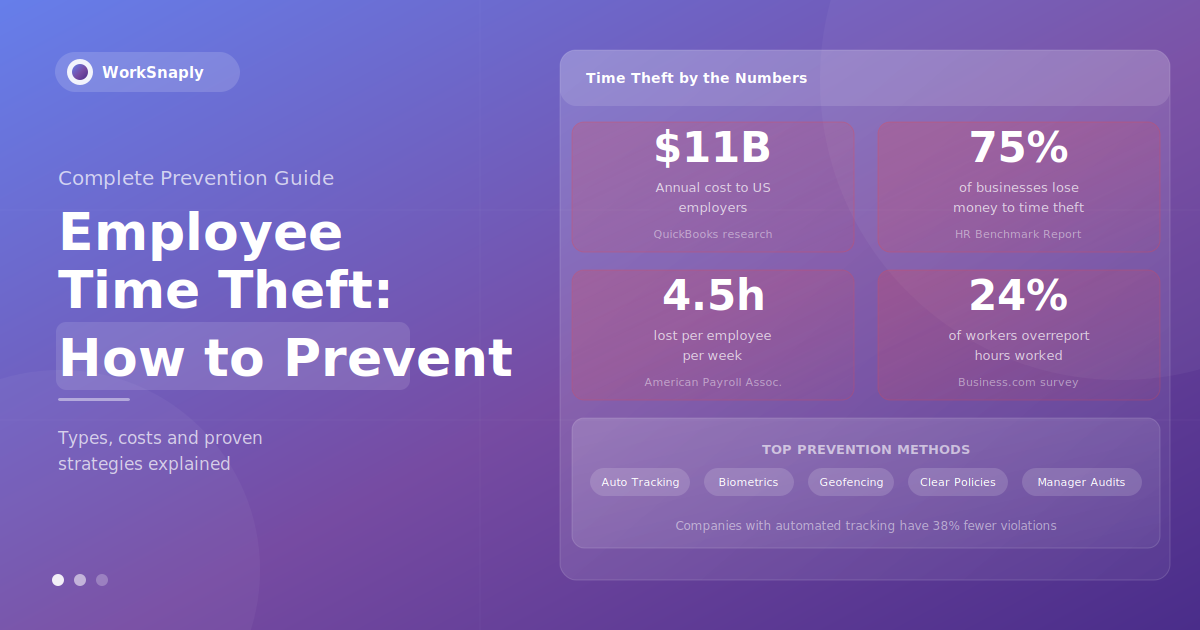
Learn what employee time theft is, the 8 most common types, how to detect it and 10 proven ways to prevent it while keeping your team's trust.
Employee time theft costs U.S. employers a significant amount every year, and the vast majority of it happens in small, unnoticed increments. A few extra minutes at lunch. Clocking in on behalf of a late colleague. Checking social media between tasks. These behaviors rarely feel like "theft" to the employees doing them, yet they compound into one of the most significant hidden costs in business payroll.
As an illustration (example numbers, not measured data): if one worker earning $20 per hour loses just one hour a week to time theft, that is about $1,040 a year (1 x $20 x 52). Across a team of 20, it is roughly $20,800 a year, before counting the productivity and morale impact that follows.
This guide breaks down every major type of employee time theft, explains why it happens, and gives you practical, proven strategies to prevent it — without damaging the team trust that drives real productivity.
What Is Employee Time Theft?
Employee time theft occurs when an employee is paid for time they didn't actually work. It can be intentional — deliberately falsifying a timesheet or clocking in for an absent colleague — or unintentional, such as an employee consistently losing track of time during breaks without realizing how the minutes accumulate.
The distinction between intentional and unintentional time theft matters for how you respond: intentional fraud warrants disciplinary action; unintentional patterns are better addressed through systems and cultural changes that make accurate time tracking easier and more natural.
Understanding timesheets is fundamental to addressing this issue — see our complete guide on what a timesheet is and how it works for the foundational context.
8 Types of Employee Time Theft
1. Buddy Punching
Buddy punching — when one employee clocks in or out on behalf of another — is the most expensive single form of time theft. Buddy punching is a common source of lost payroll dollars.
At scale, the numbers are staggering. Based on U.S. Even small amounts of buddy punching add up quickly across a large hourly workforce.
Buddy punching is most common in workplaces that use PIN-based time clocks, paper timesheets, or shared login credentials. It typically happens when an employee is running late and asks a coworker to clock in for them — a behavior that often starts as a one-time favor and becomes habitual.
2. Timesheet Falsification
Beyond buddy punching, employees may directly manipulate their own time records — rounding up clock-in times, rounding down clock-out times, or adding hours they didn't work.
Manual time entry systems are most vulnerable. When employees fill out timesheets from memory at the end of a day or week, the rounding errors and honest mistakes compound with deliberate manipulation — and both look identical in the data.
3. Extended or Unauthorized Breaks
A 30-minute lunch that regularly becomes 45. A 10-minute coffee break that stretches to 20. Individually, these seem trivial. Across a team of 15, if each person takes just one 10-minute extra break per day, that's 2.5 hours of paid, unworked time — every single day.
Extended breaks are often cultural rather than individual: if managers don't enforce break policies consistently, employees calibrate to whatever the actual standard appears to be, not the stated one. The fix is clarity and consistency, not surveillance.
4. Early Clock-Out or Late Clock-In
Arriving 10 minutes late but clocking in at the scheduled start time. Leaving 15 minutes early while recording the scheduled end time. These behaviors are among the most normalized forms of time manipulation — many employees don't consciously register them as time theft.
For a 50-person team where each employee shaves 10 minutes off both ends of their shift, the weekly payroll impact is over 83 hours of paid, unworked time.
5. Personal Tasks During Work Hours
Social media browsing, personal phone calls, online shopping, running personal errands — all represent paid work time spent on non-work activities.
This form of time theft exists on a spectrum. Occasional personal use is a normal part of working life that most employers tolerate implicitly. The issue arises when it becomes habitual and disproportionate — consuming hours rather than minutes.
Remote work has amplified this challenge. Without the social accountability of a shared office, the boundaries between work and personal time blur for many employees — not always from bad intent, but from the simple lack of structure.
6. Unauthorized Overtime
The reverse of clocking out early: employees who continue working after their scheduled shift ends and claim those hours without prior manager approval. This inflates labor costs without the corresponding business benefit of planned, project-aligned overtime.
It's common in environments where workers are paid by the hour and know their overtime will be paid automatically — particularly where managers lack real-time visibility into who is still clocked in.
7. Ghost Employees
More common in larger organizations with weak internal controls: fictitious employees entered into the payroll system, with wages directed to a real person (typically the one who created the ghost entry). This is a form of payroll fraud rather than typical time theft, but it falls under the same category of paying for work not performed.
Ghost employee schemes are typically identified through payroll audits, particularly when HR and payroll functions are handled by different people with appropriate segregation of duties.
8. Time Clock Manipulation
Direct manipulation of time clock systems — altering digital entries after submission, accessing another employee's account to modify their hours, or exploiting vulnerabilities in time tracking software. This is the most overtly fraudulent form of time theft and carries the clearest legal exposure.

Why Employees Steal Time: The Root Causes
Treating time theft purely as a moral failure misses the systemic causes that make it more or less likely in a given workplace. Understanding root causes leads to more effective prevention than enforcement alone.
- Unclear expectations: When employees aren't sure exactly what "on the clock" means for breaks, personal calls, or remote work, they fill the gap with their own interpretation — which may not match the employer's
- Perceived unfairness: Employees who feel underpaid, undervalued, or treated unfairly are significantly more likely to rationalize time theft as a form of informal compensation
- Poor management visibility: Time theft is far more common in environments where managers have little visibility into actual work patterns — absence of oversight signals that it's unlikely to be caught
- Cultural normalization: When buddy punching or extended breaks are an open secret, new employees quickly learn that these behaviors are the actual standard, not the stated one
- Friction in time tracking: When time tracking systems are cumbersome, employees cut corners — approximating rather than accurately recording, and rounding errors accumulate into patterns that look like intentional manipulation
- Remote work without structure: The blurring of work and personal time in remote environments creates genuine confusion about what constitutes "work time," particularly for salaried employees
The Real Financial Impact of Time Theft
The direct payroll impact is only part of the picture. The full cost includes:
- Direct payroll waste: The most measurable component — wages paid for time not worked
- Overtime costs: When time theft creates the appearance that more hours are needed than actually were, it can drive unnecessary overtime scheduling
- Reduced output: Time stolen is productive capacity lost — projects take longer, customer service suffers, and deliverables slip
- Morale erosion: High performers who observe time theft going unchecked become demoralized. The employees most likely to leave are those most capable of working elsewhere — the ones who care most about fairness
- Compliance risk: Inaccurate time records create legal exposure under the Fair Labor Standards Act (FLSA) and equivalent regulations in other jurisdictions. The U.S. Department of Labor enforces wage and hour rules under the Fair Labor Standards Act, which require accurate time records (DOL Fact Sheet #21).
| Team Size | Avg Wage | 20 min/day theft per person | Annual cost |
|---|---|---|---|
| 10 employees | $20/hr | $33.33/week | $17,333/year |
| 25 employees | $20/hr | $83.33/week | $43,333/year |
| 50 employees | $20/hr | $166.67/week | $86,667/year |
These figures assume 20 minutes of daily time theft per person — and the real figure varies widely by team (example numbers, not measured data).
How to Detect Time Theft
Before you can prevent time theft, you need to know where it's occurring. Key detection approaches:
Audit Time Records Regularly
Review time data weekly, not just at payroll processing. Look for patterns: employees who consistently clock in at exactly their scheduled time (unlikely without automatic tracking), frequent rounding to nice round numbers, entries that don't match project work completed, and anomalies like clock-ins without corresponding activity.
Compare Time Data Against Output
If a project team recorded 200 hours in a week but deliverable progress suggests 140 hours of actual work, the 60-hour gap is worth investigating. This requires project-level time tracking — not just total hours, but time allocated by task and project. Our guide on time tracking best practices for remote teams covers how to implement this effectively.
Set Automated Alerts
Modern time tracking software can flag anomalies automatically: clock-ins more than 10 minutes before or after scheduled start, duplicate clock-ins from the same device, unusual overtime patterns, or time entries submitted for days when the employee was marked absent. These alerts surface issues before they become patterns.
Use GPS and Geofencing for Field Workers
For employees who work at specific locations, geofencing verifies that clock-ins are happening from the right place. This doesn't prevent all time theft, but it eliminates buddy punching and location-based manipulation entirely.
Conduct Exit Interviews That Ask Specifically
Departing employees often share more candidly than current ones. Asking specifically about time tracking practices — "Did you feel the time tracking process was fair and accurate?" — can surface systemic issues you weren't aware of.
10 Proven Strategies to Prevent Employee Time Theft
1. Implement Automatic Time Tracking
The single most effective prevention measure is eliminating manual time entry wherever possible. Automatic time tracking software captures work activity in real time — detecting which applications are being used, when employees are active, and how time is distributed across projects — without requiring employees to manually log anything.
Automated time tracking can also reduce compliance errors compared with manual systems. The accuracy improvement is equally significant: automatic tracking captures time employees would have forgotten to log manually, while removing the opportunity to inflate hours.
WorkSnaply's time tracking keeps running in the background of the desktop app once an employee starts it, generating timesheet data with optional screenshots and activity levels. For a comprehensive comparison of automatic vs. manual approaches, see our guide on manual vs. automatic time tracking.
2. Use Biometric Authentication for Clock-Ins
Biometric time clocks — using fingerprint scanning or facial recognition to verify identity — make buddy punching physically impossible. Biometric clocks make buddy punching much harder, which can make them a worthwhile option for shift-based businesses.
The key consideration is proportionality: biometric systems are most appropriate for environments with high buddy punching risk (shift work, field teams, multi-location operations). For office environments and knowledge workers, automatic software tracking is typically more appropriate and less invasive.
3. Implement Geofencing for Location-Based Work
Geofencing automatically prevents clock-ins from outside a designated geographic zone — meaning field workers, delivery drivers, and site-based employees can only clock in when they're physically on site. Combined with GPS tracking, this eliminates location-based fraud entirely.
For remote teams working from home, geofencing is less applicable — but device-based activity tracking serves a similar verification function.
4. Create a Clear, Written Time Theft Policy
The most commonly overlooked prevention measure is also the simplest: a written policy that defines explicitly what constitutes time theft, what behaviors are prohibited, and what the consequences are. Without a written policy, disciplinary action becomes difficult to enforce consistently and exposes the employer to legal risk.
An effective time theft policy includes:
- A clear definition of time theft covering each major type (buddy punching, falsifying timesheets, excessive personal use, etc.)
- Explicit statement that buddy punching is prohibited — including clocking in or out for any other employee under any circumstance
- Break and overtime policies with specific time limits and authorization requirements
- Guidelines on personal device and internet use during work hours
- Consequences for violations, stated progressively (warning, written warning, termination)
- Acknowledgment signature from each employee
Communicate the policy at onboarding, reference it in the employee handbook, and review it annually. Don't wait for a violation to make people aware of it.
5. Train Managers to Review Time Data Consistently
Policies and systems are only as effective as the managers enforcing them. Managers need to be trained to review time records regularly — not just at payroll processing, but as part of their weekly routine — and to act consistently when they spot anomalies.
Inconsistent enforcement is particularly damaging: when some managers look the other way and others enforce strictly, employees learn that compliance depends on who their manager is rather than what the policy says. This erodes the policy's credibility entirely.
Our guide on time management tips for managers covers how to build this discipline into a weekly review routine without it becoming an administrative burden.
6. Give Employees Visibility Into Their Own Time Data
A counterintuitive but effective strategy: give employees access to their own time records in real time. When employees can see their logged hours, they self-correct more readily — both because discrepancies are visible and because the transparency signals that you're watching.
Employee self-service time visibility also reduces disputes about payroll errors, since employees can flag their own inaccuracies before pay processing rather than after.
7. Address Culture — Not Just Systems
If time theft is normalized in your workplace culture, no system will fully solve it. Employees who see colleagues buddy-punching without consequences learn that it's acceptable. The cultural fix requires:
- Consistent consequences: Every violation of the same policy should result in the same consequence, regardless of seniority or relationship
- Modeling from leadership: Managers who take liberties with their own time — arriving late, leaving early, using work time for personal tasks — implicitly signal that the policy applies to others, not them
- Positive reinforcement: Recognizing and rewarding accurate, reliable time tracking — rather than only responding to violations — shifts the cultural framing from punitive to supportive
8. Investigate Root Causes Before Escalating
When time theft is detected, the first question should be "why is this happening?" not "what's the punishment?" Employees who feel fairly compensated, clearly directed, and appropriately managed are significantly less likely to engage in time theft. A pattern of time theft across multiple employees is often a signal of management or compensation issues that need addressing.
This doesn't mean avoiding consequences — it means combining appropriate discipline with an honest review of whether organizational factors are contributing to the behavior.
9. Conduct Regular Payroll Audits
Regular audits catch errors early and reduce compliance risk. A quarterly audit of time records against project output, attendance records, and payroll data catches patterns before they become entrenched.
Specifically look for: employees whose hours are consistently round numbers (suggesting estimation), duplicate clock-ins, time entries on days marked as absent, and significant overtime that wasn't pre-approved.
10. Integrate Time Tracking With Payroll
When time data flows directly into payroll processing without manual transfer, you eliminate an entire category of manipulation: employees can't alter digital records in a system where everything is logged and audited. The integration also creates accountability — employees know their exact logged hours are generating their paychecks, not a manually reviewed approximation.
For a comparison of time tracking tools that offer payroll integration, see our guide on the best employee time tracking software.

Legal Consequences of Employee Time Theft
For employees, deliberate time theft can constitute fraud — a criminal offense in most jurisdictions. Employers have the legal right to:
- Terminate employees for time theft, with or without prior warning (depending on the severity and the terms of the employment contract)
- Pursue civil claims for wages paid for unworked time, particularly in cases of significant fraud
- Refer egregious cases to law enforcement for criminal fraud prosecution
However, the legal landscape cuts both ways. Employers who fail to maintain accurate time records — even if that failure is caused by employee time theft — can face liability under the Fair Labor Standards Act for wage and hour violations. This is why robust time tracking systems protect employers legally, not just financially.
It's important to consult employment counsel before terminating an employee for time theft, particularly in jurisdictions with strong employee protections, to ensure the termination is legally defensible.
Time Theft and Remote Work: Specific Challenges
Remote work hasn't increased dishonesty among employees — research consistently shows that remote workers are as productive or more productive than their office counterparts. But it has changed the nature of time theft risks and requires different prevention approaches.
The primary remote work time theft risks are:
- Blurred work/personal time boundaries: Remote workers frequently aren't sure whether checking email during dinner counts as work time, or whether a personal errand during the day needs to be deducted. Clear policies prevent unintentional theft from vague boundaries.
- Second job/"overemployment": Some remote workers hold multiple full-time positions simultaneously, splitting their attention between employers. This is an emerging category of time theft that's difficult to detect without activity monitoring.
- Inaccurate self-reporting: Without automatic tracking, remote employees filling out timesheets at the end of the day rely on memory — and consistently overestimate focused work time.
The most effective remote time theft prevention combines automatic tracking (which captures actual activity without requiring memory-based logging), clear remote work policies, and manager review practices that focus on output rather than hours. See our complete guide on improving remote employee productivity for a broader framework.
Balancing Prevention With Trust
The biggest risk in time theft prevention is overreacting. Implementing invasive monitoring — constant screenshots, keystroke logging, webcam surveillance — in response to suspected time theft typically damages the trust and morale of the majority of employees who weren't stealing time in the first place.
The goal of time theft prevention should be to create accurate, fair records — not to build a surveillance apparatus. The most effective tools are those that make accurate tracking easy for honest employees while removing the opportunity for dishonest ones.
The standard to aim for: would your best employees be comfortable with how their time is tracked? If the answer is yes, you've struck the right balance. If they'd feel surveilled and mistrusted, you've overcorrected — and you'll pay for it in engagement and retention.
Stop Time Theft Without Damaging Team Trust
WorkSnaply tracks time at the project and task level, with screenshots optional and no keystroke logging. Accurate payroll, fair records, and a team that feels trusted rather than surveilled.
Start Free 14-Day Trial — No Credit Card RequiredRelated reading
- 12 Signs You Are Being Monitored at Work (And What to Do)
- The Best Employee Monitoring Software in 2026: Complete Buyer's Guide
Frequently Asked Questions
What is the most common form of employee time theft?
Buddy punching — clocking in or out on behalf of another employee — is the most commonly cited form. Extended breaks and early clock-outs are arguably more pervasive but typically involve smaller amounts per incident.
Is employee time theft illegal?
Intentional time theft — falsifying timesheets, buddy punching, or manipulating time records — can constitute fraud and expose employees to both civil and criminal liability. Employers have the right to terminate employees for time theft and to pursue legal remedies for wages paid for unworked time. The specific legal consequences depend on the jurisdiction and the severity of the fraud.
How do I prove employee time theft?
Documentation is key. Time tracking systems with audit trails show exactly when entries were made, who made them, and whether they were edited after submission. GPS data verifies location at clock-in. Activity monitoring shows which applications were used during logged work time. Cross-referencing time records against project output and attendance records can reveal patterns that are difficult to explain through legitimate means.
Can I fire someone for time theft?
In most jurisdictions, yes — intentional time theft is a valid basis for termination. However, the legal defensibility depends on having a written policy that the employee acknowledged, documented evidence of the violation, and consistent enforcement across similar cases. Consult employment counsel before terminating, particularly in jurisdictions with strong employee protections or where the employee has an employment contract.
How much does time theft actually cost my business?
Time theft cost depends on your team. As an illustration, if each employee loses one hour a week: At $20/hour, that's $1,040 per employee per year in direct payroll waste. For a team of 20, that's potentially $20,800 annually — before accounting for reduced productivity, overtime costs, and morale impacts.
What's the best way to prevent buddy punching?
The most reliable solutions are: biometric time clocks (fingerprint or facial recognition) that verify identity physically; geofencing that only allows clock-ins from designated locations; and automatic software tracking that captures actual computer activity rather than requiring manual clock-ins. For environments where these aren't practical, unique, non-shareable credentials and a clear written policy with stated consequences provide meaningful deterrence.
Does automatic time tracking prevent time theft?
Yes — significantly. Automatic tracking removes the opportunity for most forms of time theft by capturing work activity in real time rather than relying on self-reporting. It eliminates timesheet falsification and buddy punching, reduces the impact of extended breaks (since actual activity patterns are visible), and creates audit trails that make manipulation detectable. Companies using automated tracking consistently show fewer payroll discrepancies and compliance violations than those relying on manual systems.